Lower prices for all book in Pdf format
Deep Reading and Your Brain
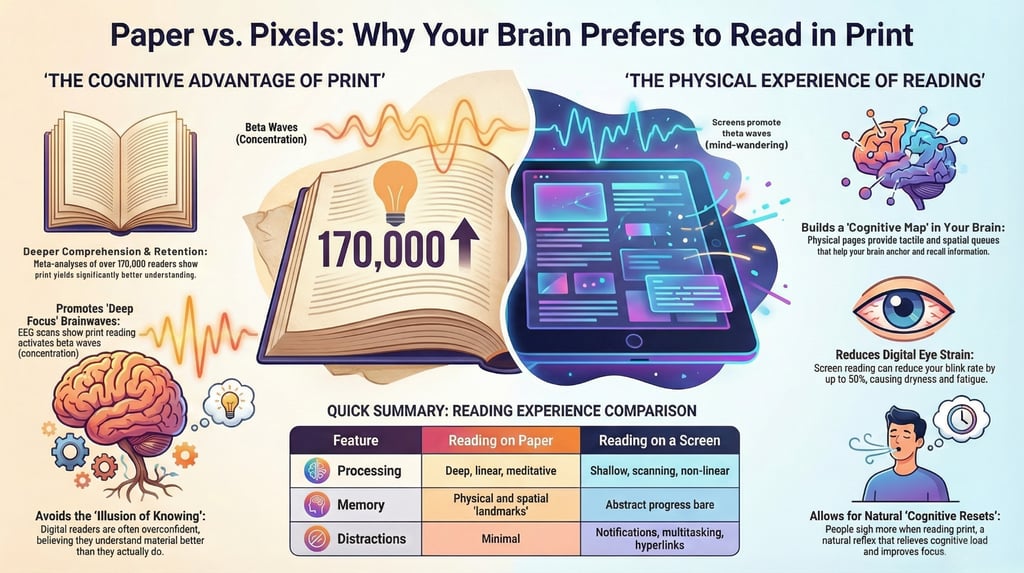
Pixel vs. Page
Five Surprising Ways Reading on Paper Rewires Your Brain
We spend our days reading on screens—scrolling through articles on our phones, reports on our laptops, and books on our tablets. Digital text is the wallpaper of modern life. But have you ever had the feeling that the information you read on a screen doesn't quite "stick" in the same way it does from a printed page? You're not alone. This is a common experience, and it's backed by a growing body of scientific evidence. The subtle differences between pixel and page have a surprisingly profound impact on the way our brains process information. Here are five ways that reading on paper rewires your brain for deeper understanding.
1. The 'Screen Inferiority Effect': You Remember Less Than You Think
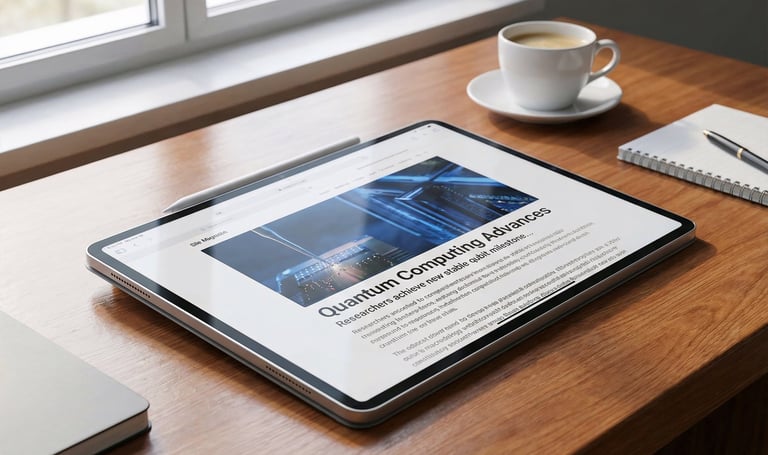
Researchers have identified a consistent phenomenon known as the "Screen Inferiority Effect," where readers of digital text comprehend and retain less information than their print-reading counterparts. This isn't just a feeling; it's a measurable deficit.
A comprehensive meta-analysis reviewing 49 separate studies confirmed this, finding that print readers consistently outperform digital readers in comprehension. The effect holds true across a wide range of age groups, from elementary school children to university adults. The power of the medium itself was highlighted in a separate eye-tracking study where, despite spending the same amount of time on the task, print readers scored a striking 24% higher on comprehension tests. This suggests that the medium—not just the content or the time spent—plays a critical role in how well we learn.
Neuroscientific studies using electroencephalograms (EEG) reveal that your brain literally operates in a different mode when reading on paper compared to a screen. The electrical frequencies of your brain waves shift, indicating different levels of mental engagement.
Reading from paper is associated with a higher prevalence of high-frequency brain waves, specifically beta and gamma waves. These patterns are linked to deep focus, active problem-solving, and the kind of locked-in concentration needed for complex learning. In contrast, screen reading tends to produce more low-frequency theta and alpha waves. These patterns are associated with a lighter mental state, reduced focus, and even mind-wandering. An EEG study on children's reading habits put it plainly:
"Results indicated that while reading from a printed paper was accompanied by higher energy in high-frequency bands (beta, gamma), reading from the screen was manifested by a higher power in the lower frequency bands (alpha, theta)."
This shift into a lighter mental state helps explain not only why we remember less, but also why our self-awareness of that deficit is so poor.


2. Your Brain Enters a Different 'Mode'
3. Physical Books Build a 'Mental Map' in Your Mind


A physical book is more than just words; it's a tangible object with dimensionality, which allows for what cognitive scientists call "embodied reading." The multi-sensory experience of a book—its weight, the texture and sound of the pages, even its smell—gives your brain more data to "hang memories on," strengthening your cognitive map of the text. The weight of the pages you've read versus those remaining and the fixed location of text on a page all act as "spatial anchors" that help you navigate information and recall where you learned something.
In a study by Mangen et al., participants who read a 28-page story in a print pocket book were significantly better at reconstructing the story's plot and timeline compared to those who read the same story on a Kindle. The physical book acts like a landscape to be explored, where you can remember that a key event happened about a third of the way through, on the left-hand page.
A screen, with its "infinite undifferentiated scroll," lacks these landmarks. It's more like standing in a single-file line at an airport—you're always moving forward, but you have no clear sense of where you are in the larger journey. This lack of embodied anchoring makes it harder to form a coherent mental representation of the text.
This dangerous illusion of competence stems directly from the brain "idling" in that lighter, less-focused state of theta and alpha waves mentioned earlier. One of the most insidious aspects of screen reading is a form of metacognitive failure: digital readers often feel more confident in their understanding, even when they perform worse on objective tests.
Because people tend to read faster on screens, they develop an overconfidence, a false assumption that this speed translates to efficient learning. In reality, that speed often leads to shallower processing. This gap between perceived and actual comprehension widens as the text becomes more complex. Digital readers skim for keywords, get the gist, and move on, but they miss the nuances and details that are crucial for true understanding. As researcher Lauren Singer Trakhman explains:
"We read digital [text] more quickly, [so] we think we must understand it better... It’s one of the best parts of our digital world... but it may also be one of the pitfalls. Everything’s so quick and accessible that we may not be truly digesting [what we read] anymore."
This illusion can be particularly detrimental in educational and professional settings, where a deep and accurate understanding is essential.
4. Screens Create an 'Illusion of Competence'
5. You're Missing Out on 'Deep Reading' and Critical Thought
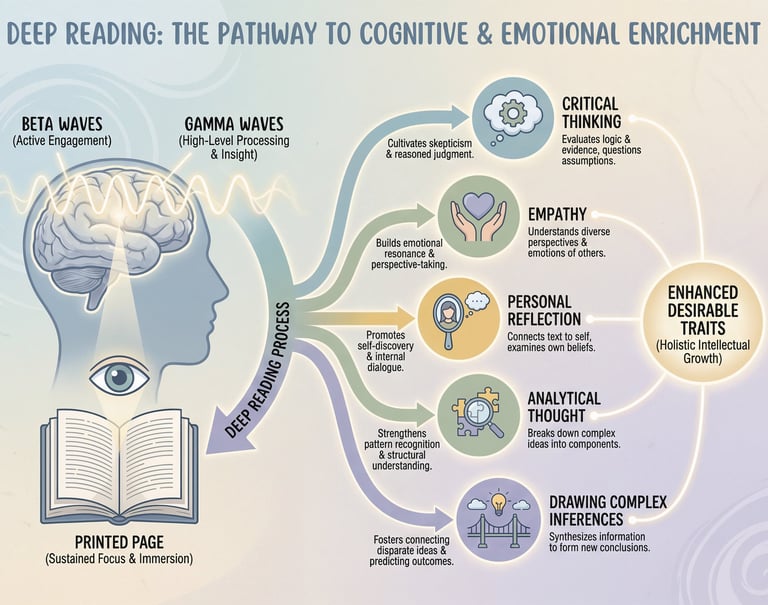
Beyond simply remembering facts, the shift to screen-based reading may be weakening our capacity for "deep reading." Neuroscientist Maryanne Wolf describes the brain's "deep reading circuit" as the foundation for our most essential intellectual abilities, including critical thinking, empathy, personal reflection, and drawing complex inferences.
This circuit is built and strengthened through sustained, linear focus. Digital environments, however, train our brains for a different kind of reading: non-linear, rapid-fire skimming. We learn to scan in an "F-pattern," hunting for keywords and darting to conclusions. Because the brain is plastic, it adapts to what we ask of it. An over-reliance on screen-reading habits can physically weaken the neural pathways required for deep, analytical thought. The concern isn't just about whether we remember the plot of a story, but whether we are preserving the cognitive patience required to weigh different perspectives, understand complex arguments, and connect with the emotional states of others—skills that are vital for a thoughtful and democratic society.
The goal is not to demonize screens. They are incredibly powerful tools for quick information retrieval, communication, and accessing a world of knowledge. Instead, the science encourages us to be deliberate about which medium we choose for which task.
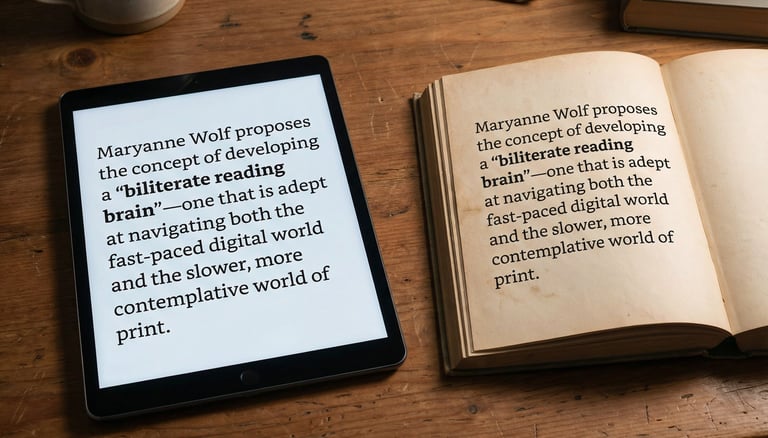
Maryanne Wolf proposes the concept of developing a "biliterate reading brain"—one that is adept at navigating both the fast-paced digital world and the slower, more contemplative world of print. A biliterate reader knows when to skim a screen for headlines and when to pick up a physical book to truly immerse themselves in a complex topic. By understanding how each medium affects our thinking, we can make conscious choices to build and maintain both sides of our reading brain.
In a world demanding both speed and wisdom, how will you choose to build and maintain both sides of your reading brain?
Conclusion: Cultivating a 'Biliterate Brain'
Bargain Books
Explore our website for new and interesting titles.
Contact
760-904-4601
© 2026. All rights reserved.